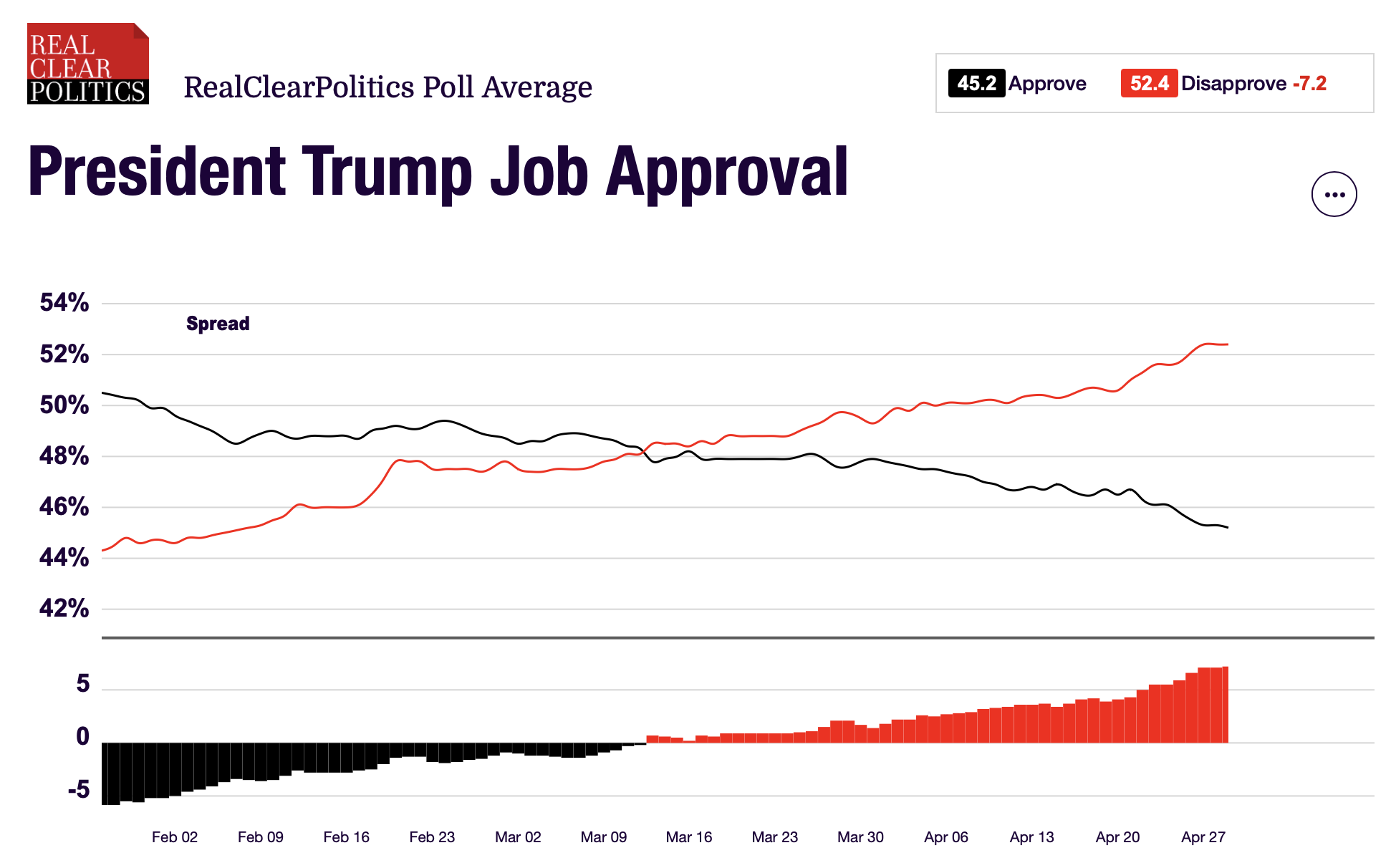
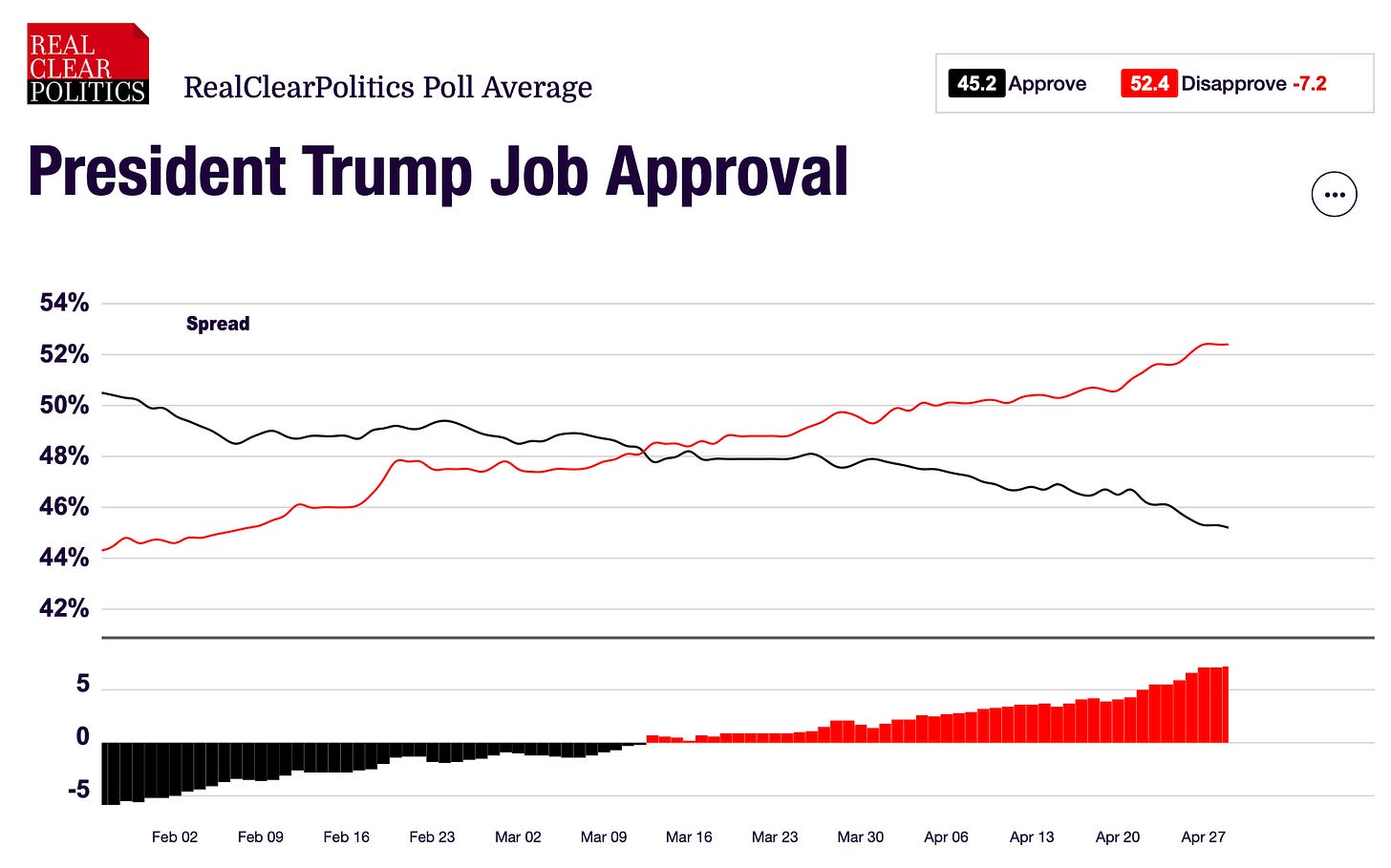
Polls don’t lie—but they do lag. Donald Trump’s current numbers are under pressure, and not just from the usual partisan resistance. A deeper erosion is setting in: disapproval among independents, weakening support in battleground states, and a growing fatigue even within Republican ranks. The pressing question isn’t whether his ratings can fall further—it’s how low they can go. And for an answer, we don’t need to speculate. We have a precedent: George W. Bush, whose second term spiraled into one of the most sustained collapses in modern presidential popularity.
Trump’s trajectory today mirrors Bush’s descent in 2006–2008. The warning signs are visible. The patterns are repeating. And if history is any guide, Trump’s poll numbers have room to plummet—possibly below 30%, where recovery becomes nearly impossible.
The Bush Blueprint: How a Presidency Crumbles
George W. Bush entered his second term with 51% approval after winning re-election in 2004. By 2006, it had dropped to 37%. By late 2008, it bottomed out at 22%—the lowest end-of-term approval for any modern president.
What drove that collapse?
- Iraq War fatigue: Once the justification for invasion unraveled, public trust evaporated.
- Hurricane Katrina mismanagement: The federal response exposed systemic incompetence.
- Economic collapse: The 2008 financial crisis sealed Bush’s reputation as out of touch.
- Partisan overreach: GOP scandals and perceived cronyism eroded institutional confidence.
Bush didn’t just lose popularity—he lost the center. Independents abandoned him. Suburban moderates tuned out. Even core conservatives grew disillusioned.
Trump faces a similar convergence of crises: legal battles, inflation concerns, immigration fallout, and a perceived lack of preparedness for global instability. The parallels aren’t perfect, but the structural vulnerabilities are.
Trump’s Current Polling Floor: Where Are We Now?
As of mid-2024, Trump’s net approval in hypothetical 2025 scenarios hovers around 40–43% in major tracking polls (Gallup, Pew, 538 aggregation). But among battleground-state voters, the numbers are worse.
In key swing states: - Michigan: 38% favorable, 52% unfavorable - Arizona: 37% favorable, 54% unfavorable - Pennsylvania: 39% favorable, 53% unfavorable - Georgia: 41% favorable, 51% unfavorable
These aren’t just numbers—they’re warning signals. Unlike Bush, who enjoyed unified Republican control early in his second term, Trump would enter office facing potential investigations, a divided Congress, and a mobilized opposition. That combination accelerates a downward spiral.
The real danger zone starts below 35% approval. That’s the threshold where even a base-driven campaign can’t compensate. Bush hit that mark in early 2008. Trump could reach it faster.
The 30% Threshold: When Collapse Becomes Inevitable
Below 35%, presidential credibility fractures. Below 30%, governing becomes nearly impossible.
Bush’s 22% approval in 2008 meant: - Zero legislative momentum - Cabinet resignations and staff turnover - Hostile media coverage that hardened into narrative - Party leaders distancing themselves
Trump risks the same. At 30% approval: - Fundraising stalls—not just for the presidency, but down-ballot - Moderates abandon the party en masse - Media framing shifts from “contender” to “liability” - Even Fox News segments begin to question leadership
And unlike Bush, Trump lacks institutional party loyalty. Many GOP senators and governors already hedge their bets. Once approval dips below 35%, defections accelerate.
Why Trump’s Fall Could Be Faster—And Deeper
Bush’s decline took four years. Trump’s could unfold in 18 months. Here’s why:
1. Legal Pressure as a Constant Drag Bush faced no indictments. Trump enters any potential second term under multiple criminal convictions or trials. Legal headlines dominate news cycles, reinforcing narrative of instability.
2. Polarization Works Both Ways While Trump’s base is loyal, polarization means any misstep triggers an outsized backlash. Bush had room to disappoint. Trump has less.
3. Social Media Amplifies Downward Spikes A single gaffe, controversial pardon, or diplomatic misstep can trend globally within minutes. There’s no off-cycle reprieve.
4. Economic Sensitivity Is Higher Inflation, housing costs, and student debt make voters quicker to punish incumbents. Even if Trump isn’t president yet, his association with GOP policy drags his numbers.
In 2008, Bush’s low approval didn’t immediately sink John McCain—though it didn’t help. In 2028, a Trump below 30% could torpedo the entire Republican ticket.
Bush 2.0 and the Rebrand That Failed
After Bush’s collapse, the GOP spent years rebranding. They pivoted to fiscal conservatism, Tea Party energy, and anti-establishment messaging—eventually paving the way for Trump’s 2016 rise.
But here’s the irony: Trump is now facing the same fate he once exploited.
Bush became toxic. So did the “W” brand. The party had to reinvent itself.
If Trump’s numbers crash to Bush 2008 levels, the GOP faces a similar reckoning. Can the party survive a second brand collapse in 20 years? Can it pivot again?
Not easily. The conservative ecosystem is now more personality-dependent than policy-driven. When the personality becomes radioactive, the entire structure wobbles.
Real-World Implications: Beyond the Polls
Low approval ratings don’t just affect re-election. They reshape governance.
Consider: - Judicial nominations stalled—even friendly senators hesitate to back controversial picks - Foreign policy weakened—allies question U.S. stability - Cabinet recruitment suffers—qualified officials avoid a sinking ship - Protests and unrest increase—low legitimacy invites public defiance
During Bush’s final two years, protests over Iraq continued, climate inaction drew youth backlash, and federal agencies operated in crisis mode.
Trump could face broader dissent: over abortion rulings, election denialism, or executive overreach. And with digital mobilization, resistance scales faster.
Historical Precedent vs. Trump’s Resilience
Yes, Trump is different. He thrives in controversy. He weaponizes media attacks. His base forgives what would sink other politicians.
But even Trump can’t defy gravity forever.
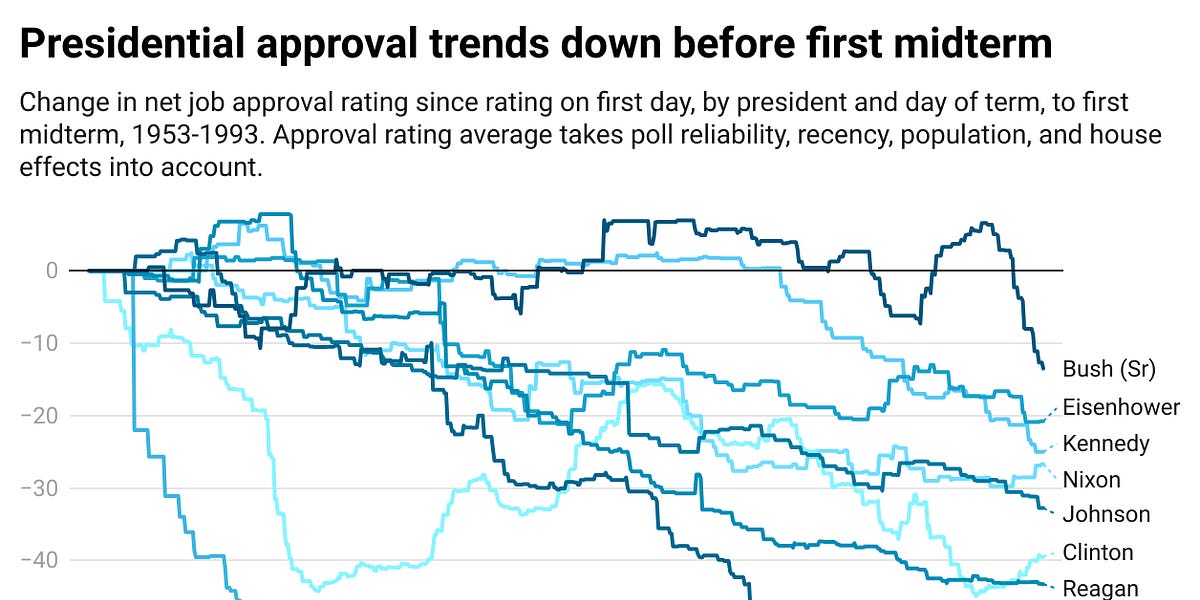
Ronald Reagan dipped to 35% in 1982 during a recession—yet rebounded with economic recovery and strong leadership. Bush 41 hit 29% in 1992—lost re-election. Carter bottomed at 28% in 1980—crushed by Reagan.
The pattern is clear: below 35%, re-election odds collapse unless a dramatic turnaround occurs.
Trump’s challenge? There’s no obvious reset button. No war victory. No economic boom on the horizon. No unifying crisis to rally around.
Instead, he faces legal constraints, global instability, and a deeply skeptical electorate.
The Path to 25%: A Realistic Scenario
Could Trump go lower than Bush?
Possibly.
A confluence of events could drive approval below 25%: - A major recession in year one - A pardoned ally later charged with treason or espionage - A failed attempt to overturn election results in a state legislature - A diplomatic incident (e.g., NATO rift, Ukraine funding collapse) - A mass protest labeled “insurrection” by media
Each event alone might cost 2–3 points. Together, they could erase 15–20 points from baseline.
Bush hit 22%. Trump could hit 20%—and stay there.
What Comes After: The GOP’s Existential Choice
When Bush’s ratings collapsed, the GOP searched for a “new generation” of leaders. They got Obama—and a Democratic wave.
If Trump crashes to similar depths, the party faces a reckoning: - Do they double down on Trumpism? - Do they purge Trump allies and pivot to reform? - Or do they fracture into warring factions?
The Tea Party rose from Bush’s ashes. A “New Right” or “Post-Trump Conservatism” could emerge from the rubble—if the base allows it.
But right now, the base still follows Trump. And as long as he leads the party, his approval numbers will dictate its fate.
Low presidential approval isn’t just a number. It’s a domino. And once it falls, it knocks over legislation, morale, credibility, and electoral viability.
Trump’s poll numbers can go lower. Bush 2.0 proved it. The question isn’t if—it’s how fast, and what happens when they do.
For the GOP, the answer could reshape American politics for a generation.
Monitor the trends. Watch the swing states. And remember: no president is immune to the math of disapproval.
5 FAQ
How low did George W. Bush’s approval rating go? Bush’s approval bottomed out at 22% in late 2008, according to Gallup, making it the lowest end-of-term rating in the modern polling era.
Can a president win re-election with sub-30% approval? No modern president has done so. Approval below 35% historically signals a high likelihood of electoral loss.
Is Trump’s legal situation affecting his polls? Yes. Ongoing indictments correlate with declining favorability, especially among independents and suburban voters.
How do swing state polls differ from national numbers? Swing states like Arizona, Georgia, and Pennsylvania show Trump’s unfavorables running 10–15 points higher than national averages.
Could Trump recover if his numbers drop below 30%? Historically, recovery from below 30% is rare. Reagan rebounded from 35%, but no president has escaped 25% without a major crisis or war.
FAQ
What should you look for in How Low Can Trump’s Polls Go? Bush 2.0 Holds Clues? Focus on relevance, practical value, and how well the solution matches real user intent.
Is How Low Can Trump’s Polls Go? Bush 2.0 Holds Clues suitable for beginners? That depends on the workflow, but a clear step-by-step approach usually makes it easier to start.
How do you compare options around How Low Can Trump’s Polls Go? Bush 2.0 Holds Clues? Compare features, trust signals, limitations, pricing, and ease of implementation.
What mistakes should you avoid? Avoid generic choices, weak validation, and decisions based only on marketing claims.
What is the next best step? Shortlist the most relevant options, validate them quickly, and refine from real-world results.