
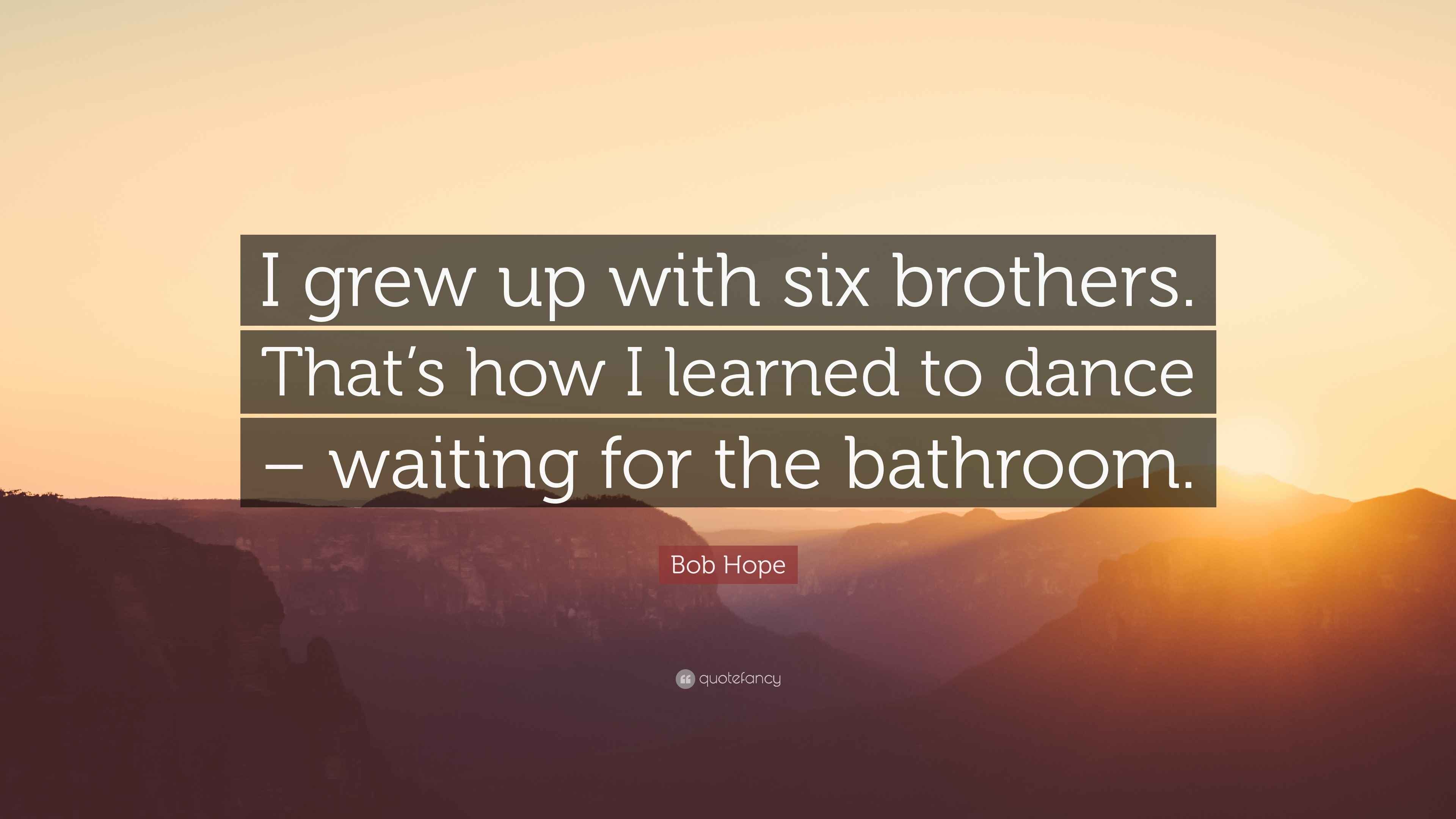
Growing up in a household with six brothers didn’t just shape Bob Hope’s sense of humor—it forged his worldview. The legendary entertainer once quipped, “I grew up with six brothers—that’s how I learned to dance.” On the surface, it’s vintage Hope: quick, self-deprecating, and disarmingly funny. But beneath the punchline lies a deeper commentary on competition, survival, and the unspoken choreography of family life. This single line offers a surprising lens into broader life lessons on relationships, aging, and even political navigation—all wrapped in a comedian’s timing.
Bob Hope wasn’t just a joke machine. For decades, his humor carried social observation, resilience, and emotional intelligence. That one-liner about dancing isn’t really about rhythm—it’s about adaptation, awareness, and learning to move without stepping on toes. Let’s unpack how this deceptively simple quote reveals timeless truths.
The Real Meaning Behind “I Learned to Dance”
Bob Hope’s statement—“I grew up with six brothers—that’s how I learned to dance”—is often shared as a throwaway zinger. But it’s rooted in truth. Born Leslie Townes Hope in 1903, he was one of seven boys in a working-class English immigrant family in Cleveland. Space was tight. Attention was scarce. Survival required agility.
In such a household, “dancing” wasn’t literal. It was metaphorical—navigating crowded rooms, competing for food, attention, and bathroom time. It was about timing, evasion, and knowing when to step forward or back. In essence, Hope learned emotional and social choreography long before he stepped on stage.
This form of physical and psychological maneuvering mirrors real-life relationship dynamics. Whether in marriage, friendship, or workplace alliances, success often depends not on dominance, but on rhythm—knowing when to lead, when to follow, and when to simply get out of the way.
Practical takeaway: Healthy relationships aren’t about winning every exchange. They’re about flow. Just as Hope had to move with his brothers, we must learn to adjust our pace, tone, and presence depending on the people around us.
Brotherhood as a Training Ground for Emotional Intelligence
Having six brothers wasn’t just about competition. It was an immersion course in human behavior. Siblings teach us how to read cues, negotiate conflict, and build loyalty—all without formal instruction.
Hope’s humor often reflected this early education. His comedy wasn’t cruel; it was observational, situational, and deeply empathetic. He understood how people operate under pressure, how egos clash, and how laughter diffuses tension.
This upbringing shaped his ability to connect with diverse audiences—from troops in war zones to presidents in the Oval Office. He didn’t just perform; he related.
Real-world application: Many people struggle with conflict because they lack early exposure to high-stakes interpersonal dynamics. But families like Hope’s—large, loud, and competitive—force emotional development early. Consider these behaviors he likely mastered:
- Reading body language to avoid fights
- Using humor to defuse tension
- Compromising to gain access (e.g., bathroom time, dinner portions)
- Building alliances within the sibling hierarchy

These aren’t just survival tactics. They’re core emotional intelligence skills used by effective leaders, partners, and negotiators.
Humor as a Survival Tool in Relationships
Hope’s quote is funny because it’s relatable. But more importantly, it reveals how humor functions as a coping mechanism—and a relationship lubricant.
Growing up with six brothers meant constant friction. Jokes were likely a way to:
- Deflect aggression
- Gain favor
- Elevate status without confrontation
In adult relationships, this same principle applies. Couples who laugh together report higher satisfaction. Teams with shared humor are more collaborative. Even in grief, humor helps people reconnect.
But there’s a fine line between wit and wounding. Hope’s comedy rarely punched down. He mocked himself, authority, and absurdity—but seldom individuals. That balance kept his humor inclusive rather than alienating.
Common mistake: Many people use sarcasm or teasing to assert dominance in relationships. But without warmth, it erodes trust. Hope’s success came from pairing sharp timing with evident goodwill.
Workflow tip: In tense moments, ask: “Is this joke connecting or distancing?” If it highlights shared absurdity, it’s likely helpful. If it singles someone out for flaws, it’s probably harmful.
Aging with Grace: Lessons from a 60-Year Career
Bob Hope performed well into his 80s. His career spanned vaudeville, radio, film, television, and USO tours. He didn’t just age in the public eye—he redefined what aging in entertainment could look like.
His quote about dancing with brothers takes on new meaning when viewed through the lens of longevity. The same agility that helped him survive childhood chaos helped him adapt to shifting cultural norms, technological changes, and evolving audience tastes.
While many of his contemporaries faded, Hope remained relevant by:
- Embracing new media (TV, satellite broadcasts for troops)
- Updating his material without losing his voice
- Staying active in causes (especially military support)
He didn’t resist aging. He danced with it.
Key insight: Aging isn’t about holding on—it’s about adjusting your rhythm. Just as Hope learned to move among his brothers, he learned to move with the times. That adaptability is a model for anyone navigating midlife or later years.
Limitation to note: Hope’s brand of humor, while groundbreaking in its era, sometimes relied on dated stereotypes. Modern audiences may find certain bits uncomfortable. This underscores another life lesson: even the best dancers sometimes misstep. Growth means acknowledging when the music has changed.
Politics and Punchlines: Navigating Divided Rooms
Hope performed for eight U.S. presidents. He was a Republican, but his comedy avoided partisan venom. Instead, he mocked the office, not the person. He joked about bureaucracy, not ideology.
His brother-filled upbringing likely trained him for this. In a house of seven boys, you can’t afford to alienate half the room. You need jokes that unite, not divide.
This approach is increasingly rare. Today’s comedians often preach to the choir. But Hope understood that true influence comes from speaking to everyone in the room—even when they disagree.
Use case example: Imagine leading a team with polarized views. A Hope-style approach would involve:
- Highlighting shared frustrations (e.g., “We all hate slow Wi-Fi”)
- Using self-deprecation (“I can’t even set my thermostat”)
- Avoiding identity-based jokes
The goal isn’t neutrality—it’s cohesion. Humor becomes a bridge, not a weapon.
His USO tours during WWII, Korea, and Vietnam proved this. Soldiers from all backgrounds laughed at the same jokes. In moments of national division, Hope’s comedy offered common ground.
The Dance of Daily Life: Applying Hope’s Wisdom Today
Bob Hope’s quote isn’t just nostalgic. It’s a framework for modern living.
Consider how “dancing” applies to:
- Workplace dynamics: Navigating office politics without stepping on toes
- Parenting: Sharing attention among siblings (sound familiar?)
- Online interactions: Knowing when to engage, when to retreat
- Conflict resolution: Moving with someone, not against them
The family dinner table was Hope’s first stage. But the habits he formed there—awareness, timing, humility—served him on global ones.
Actionable exercise: For one week, treat every interaction as a dance. Notice:
- Who’s leading? Who’s following?
- When do you push versus yield?
- Can you use humor to reset tension?
You’ll likely find that the most effective people aren’t the loudest—they’re the most rhythmically aware.
Why This Quote Still Matters
In an age of viral outrage and polarized discourse, Bob Hope’s humor feels refreshingly human. He wasn’t trying to win arguments. He was trying to keep the room together.
His quote about growing up with six brothers isn’t just a laugh line. It’s a masterclass in emotional agility. It teaches us that:
- Crowded spaces require sensitivity
- Competition doesn’t have to be destructive
- Humor builds resilience
- Aging is not decline—it’s a change in tempo
Hope’s legacy isn’t just in punchlines. It’s in the quiet wisdom beneath them.
Move with others. Listen to the rhythm. And when things get crowded—dance.
FAQ
What did Bob Hope mean by “I learned to dance”? He used humor to describe surviving a crowded, competitive household. “Dancing” symbolizes the skill of navigating tight spaces and complex relationships.
How many brothers did Bob Hope have? Bob Hope had five full brothers and one half-brother, making six in total. They were a central part of his upbringing and storytelling.
Did Bob Hope serve in the military? No, Bob Hope did not serve, but he performed for U.S. troops for over 50 years through USO tours, becoming a symbol of morale support.
Was Bob Hope political? He identified as a Republican and supported several conservative figures, but his comedy generally avoided partisan attacks, focusing instead on universal experiences.
What is Bob Hope’s most famous quote? While many know his “dance” line, another famous one is: “I’ve been in show business 60 years—58 of them uphill.”
How did Bob Hope stay relevant for so long? By adapting to new media, maintaining a clean comedic style, and focusing on timeless themes like family, fear, and failure.
Can humor improve relationships? Yes, when used empathetically. Shared laughter builds connection, reduces tension, and fosters emotional resilience—just as Hope demonstrated throughout his life.
FAQ
What should you look for in Bob Hope’s Life Lessons: Brotherhood, Wit, and Wisdom? Focus on relevance, practical value, and how well the solution matches real user intent.
Is Bob Hope’s Life Lessons: Brotherhood, Wit, and Wisdom suitable for beginners? That depends on the workflow, but a clear step-by-step approach usually makes it easier to start.
How do you compare options around Bob Hope’s Life Lessons: Brotherhood, Wit, and Wisdom? Compare features, trust signals, limitations, pricing, and ease of implementation.
What mistakes should you avoid? Avoid generic choices, weak validation, and decisions based only on marketing claims.
What is the next best step? Shortlist the most relevant options, validate them quickly, and refine from real-world results.