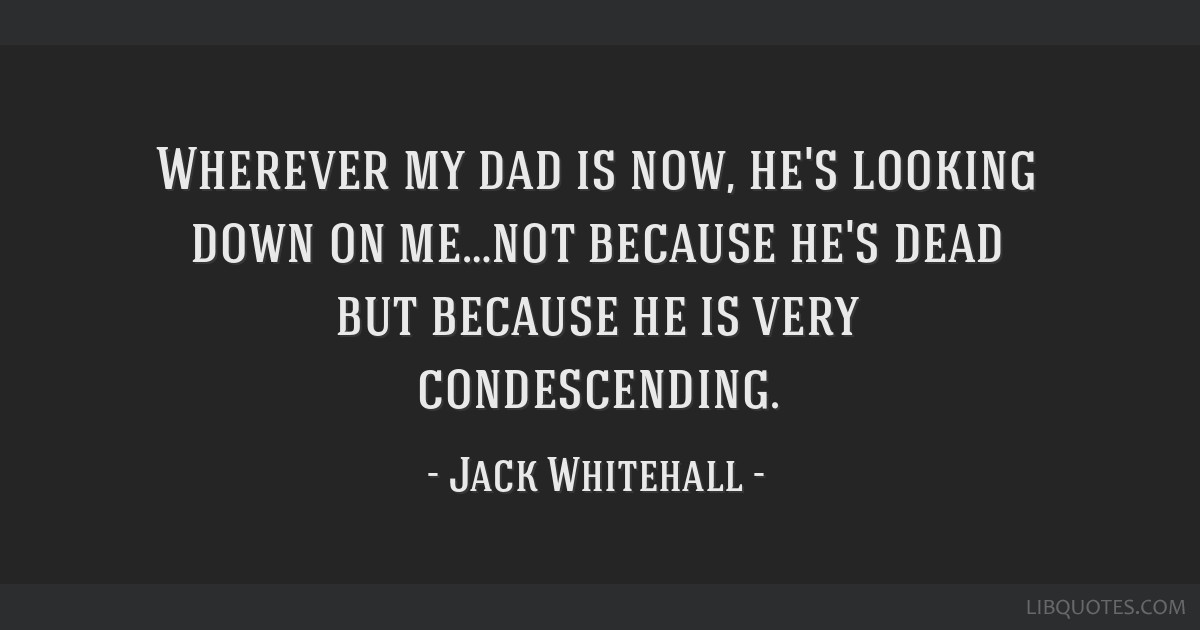
There’s a moment in Jack Whitehall’s stand-up where he delivers a line so perfectly timed, so absurdly honest, that it stops audiences mid-laugh and makes them rethink everything they know about family, dignity, and truth. “I’m sure wherever my dad is, he’s looking down on us. He’s not dead—just very, very high up.” It’s a quote that went viral not just because it’s funny, but because it encapsulates a deeper truth about modern relationships, performance, and the masks we wear—even at home.
This isn’t just a punchline. It’s a commentary.
Jack Whitehall, the English comedian, actor, writer, and television personality, has built a career on dissecting the awkward, the privileged, and the painfully real. His dynamic with his father, Michael Whitehall, is central to his brand—equal parts satire and sincerity. And in that single quote—“I’m sure wherever my dad is, he’s looking down on us. He’s not dead—just very, very high up”—lies a goldmine of insight about honesty, workplace dynamics, and the contradictions of human nature.
Let’s unpack it—not as fans, but as observers of culture.
The Genius of Comedic Honesty
Whitehall’s humor thrives on contradiction. He presents himself as the spoiled, emotionally stunted millennial, while casting his aristocratic father as a detached, old-world relic. But beneath the caricatures is a commitment to truth-telling disguised as self-deprecation.
When he says his dad is “looking down on us,” he’s mocking the cliché reserved for the deceased—yet flipping it to expose the emotional distance in their relationship. His father is literally and figuratively “high up”—aloof, emotionally guarded, physically distant during much of Jack’s life.
This kind of humor doesn’t just entertain. It disarms. And in that disarming moment, real reflection occurs.
Comedians like Whitehall operate as cultural surgeons. They cut through social pretense with laughter, revealing the rot—or the resilience—beneath. His quote isn’t about grief. It’s about presence. About how people can be physically close but emotionally miles apart.
And in a world where “looking down on someone” usually means judgment, Whitehall hijacks the phrase to highlight both physical elevation (rich people living on hills?) and emotional detachment—all with a smirk.
Work Culture Through a Comedic Lens
Now, stretch that insight into the workplace.
How many leaders “look down on” their teams—not from death, but from privilege, ego, or disconnection?
Whitehall’s joke resonates in corporate environments where hierarchy kills honesty. Executives in corner offices, remote managers who only appear on Zoom calls, or leaders who delegate empathy like it’s a quarterly task—they’re all “very high up,” just like Michael Whitehall.
But here’s the parallel: Jack’s comedy forces a reckoning. He doesn’t just point fingers—he implicates himself. He’s not the innocent son; he’s the one who weaponizes vulnerability for laughs, who craves approval but mocks the giver.
In work culture, that duality is critical.
The best teams aren’t those without conflict—they’re the ones where conflict is voiced, where feedback flows both ways, and where leaders don’t just “look down” but occasionally kneel to listen.
Whitehall’s dynamic with his father teaches a subtle lesson: transparency builds connection, even when it’s uncomfortable. His Netflix travel specials—Jack Whitehall: Travels with My Father—are not just comedy gold; they’re case studies in bridging emotional gaps through shared experience.
Apply that to leadership: the most effective managers aren’t the ones who command from above. They’re the ones who travel with their team—through challenges, failures, and awkward silences.
The Performance of Self in Modern Life
Jack Whitehall doesn’t just perform on stage. His entire persona—on TV, in interviews, in public—is a calibrated act of exaggeration and truth.
That quote isn’t just about his dad. It’s about performance.
We all play roles: the dutiful employee, the caring partner, the successful friend. Like Whitehall, we craft narratives that make us palatable, likable, or powerful. But at what cost?
When Whitehall jokes that his father is “looking down on us,” he’s also commenting on how we mythologize our relationships. We say “my dad’s my best friend” when the truth might be more complicated. We claim “we’re like a family” at work, even when the culture is toxic.
His quote exposes the gap between performance and reality.
And in that gap lies the core of human nature: our need to belong, to impress, to survive socially—even if it means distorting the truth.
Consider the workplace parallel: the employee who says “I’m fine” while drowning in burnout. The manager who pretends to value feedback but shuts down dissent. The culture that celebrates “transparency” but punishes honesty.
Whitehall’s humor works because it’s honest about dishonesty.
Honesty as a Professional Superpower
If there’s one transferable lesson from Jack Whitehall’s comedy, it’s this: vulnerability, when wielded with intention, is power.
In one of his stand-up routines, he recounts trying to impress his father by pretending to enjoy cigars, polo, and private members’ clubs—only to fail spectacularly. The joke lands because it’s relatable. We’ve all faked competence, confidence, or interest to fit in.
But Whitehall doesn’t just highlight the fakery—he reveals the relief that comes when the mask slips.
That’s a radical concept in professional settings.
Too many workplaces reward image over integrity. Employees learn to say the right things, wear the right clothes, and suppress their true opinions. But culture built on performance collapses under pressure.
Compare two teams:
- Team A: Everyone agrees in meetings, nods at leadership, and avoids conflict. The surface is smooth—but innovation is stagnant, and turnover is high.
- Team B: People challenge ideas, admit mistakes, and question assumptions. There’s friction—but also trust, creativity, and loyalty.
Team B wins in the long run.
And the catalyst? Permission to be honest—like Jack giving himself permission to say, “My dad doesn’t really get me, and that’s okay.”
Honesty isn’t just personal. It’s cultural infrastructure.
Human Nature: The Comedy of Contradiction
Jack Whitehall is wealthy. Privileged. Educated at elite schools. And yet, his comedy resonates because it exposes universal insecurities: the need for approval, the fear of failure, the absurdity of social rituals.
That’s the heart of his quote. It’s not really about his dad being high up. It’s about the lengths we go to for connection—even when the tools we use are broken.
Human nature is full of these contradictions:
- We crave authenticity but reward performance.
- We say we want feedback but punish candor.
- We claim to value family but prioritize work.
Whitehall holds a mirror to these hypocrisies—not with anger, but with laughter. And laughter, when rooted in truth, becomes transformative.
Think about the last time someone told you a hard truth wrapped in humor. It likely landed better than a lecture. That’s the power of comedic insight: it bypasses resistance.
In organizations, leaders who can blend honesty with levity—like Whitehall—build deeper trust. They don’t just command; they connect.
Real-World Applications: Bringing the Joke to Life
How do you apply Jack Whitehall’s ethos beyond the comedy club?
Consider these actionable uses:
- In Leadership
- Replace top-down announcements with open forums. Ask, “What’s something you think I’d hate to hear—but need to?” Reward the first honest answer.
- In Team Building
- Host a “vulnerability roundtable” where people share a professional failure and what it taught them. Model it from the top.
- In Feedback Culture
- Ban “I’m fine” as a status update. Replace it with a mood spectrum: “I’m thriving,” “I’m coping,” “I’m drowning.” Normalize the full range.
- In Personal Growth
- Keep a “performance journal.” Note when you’re acting versus being real—at work, at home, in relationships. Awareness is the first step to alignment.
- In Communication
- Use humor—carefully—to broach tough topics. A well-placed joke can open doors that lectures slam shut.
The goal isn’t to become a comedian. It’s to steal their tools: timing, truth, and the courage to expose the absurd.
Why This Quote Endures
“I’m sure wherever my dad is, he’s looking down on us. He’s not dead—just very, very high up.”
It’s short. It’s funny. It’s shareable.
But it lasts because it’s layered.
It’s about class. It’s about family. It’s about the stories we tell to make sense of emotional distance. And in a world where so much communication is curated, performative, or algorithm-driven, it feels refreshingly unfiltered.
Jack Whitehall isn’t just a comedian. He’s a chronicler of modern disconnection—and a guide to bridging it.
Not through grand gestures. But through laughter, honesty, and the willingness to say, “Yeah, my dad doesn’t really get me. And yours probably doesn’t either. And that’s okay.”
That’s the real life lesson.
Bring more truth into your conversations. Use humor as a bridge, not a shield. And the next time someone says, “My dad’s looking down on me,” ask—really ask—if they mean from heaven… or just from a very tall house.
FAQ
What should you look for in Jack Whitehall’s Quote of the Day: Humor, Honesty, and Human Truths? Focus on relevance, practical value, and how well the solution matches real user intent.
Is Jack Whitehall’s Quote of the Day: Humor, Honesty, and Human Truths suitable for beginners? That depends on the workflow, but a clear step-by-step approach usually makes it easier to start.
How do you compare options around Jack Whitehall’s Quote of the Day: Humor, Honesty, and Human Truths? Compare features, trust signals, limitations, pricing, and ease of implementation.
What mistakes should you avoid? Avoid generic choices, weak validation, and decisions based only on marketing claims.
What is the next best step? Shortlist the most relevant options, validate them quickly, and refine from real-world results.